
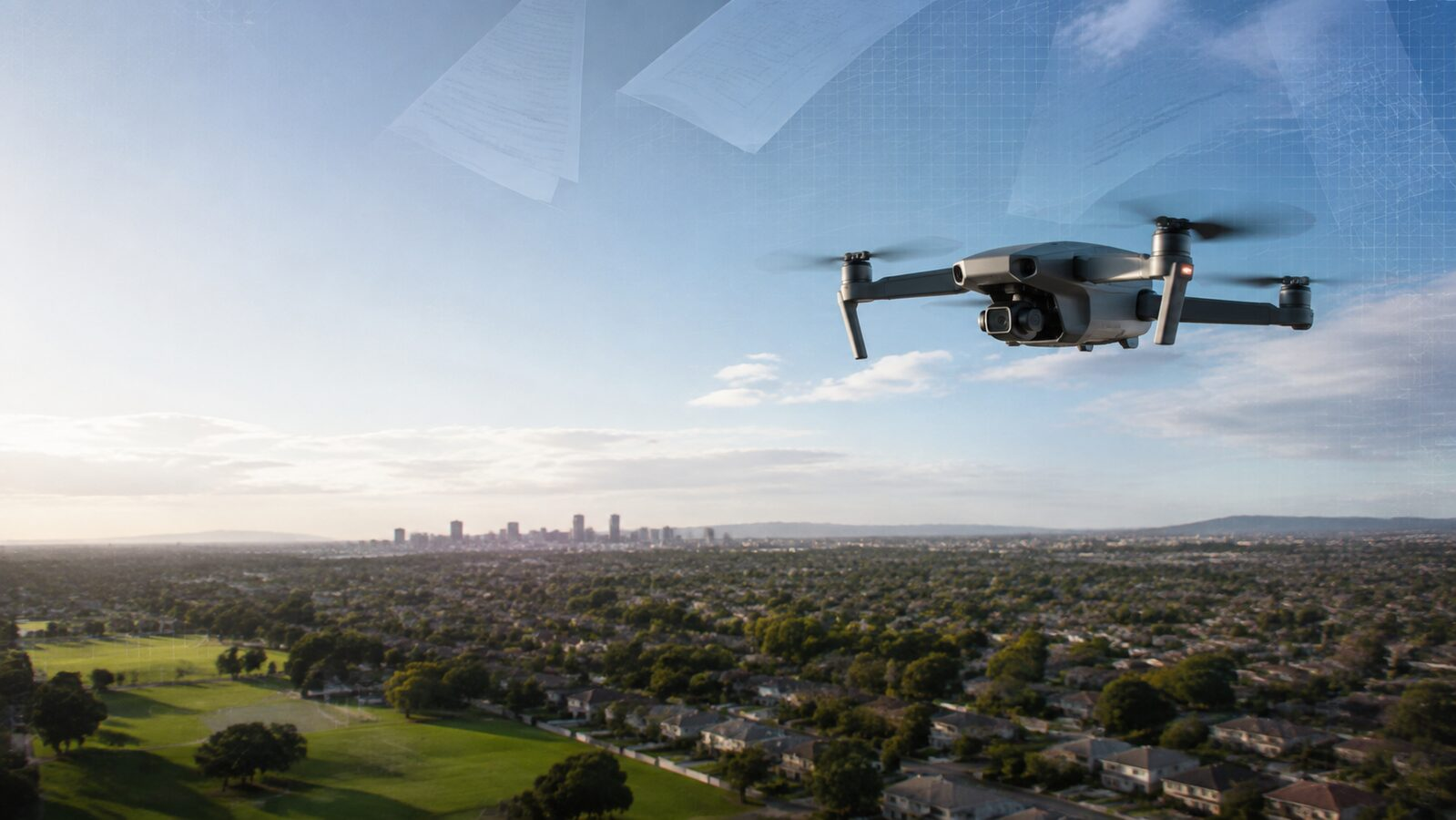
A new Federal Communications Commission proposal could restrict future U.S. imports and sales of certain foreign-made drones that have already received federal equipment authorization.
The proposal does not ground drones people already own. It could, however, affect whether some currently available aircraft, components, and supporting equipment remain on the U.S. market.
That distinction has prompted DJI and drone-industry advocates to urge pilots, public-safety agencies, farmers, businesses, and recreational users to submit comments before the federal comment period closes on September 2, 2026.
The outcome of the proceeding—PS Docket No. 26-189—could help determine which previously approved foreign-made drone systems remain available for future purchase.
The essential facts
- The FCC has not adopted the proposed restrictions.
- The proposal concerns future importation, marketing, and sales of certain previously authorized foreign-produced drones and critical components.
- People could continue using affected drones they already own.
- The FCC is considering several capability-based definitions, including thermal imaging, LiDAR, agricultural dispensing, docking systems, swarming capabilities, and certain heavier aircraft.
- Public comments are due September 2, 2026.
- Comments can be filed under PS Docket No. 26-189.
How the regulatory situation reached this point
In December 2025, the FCC added foreign-produced unmanned aircraft systems and critical components to its Covered List.
Equipment on that list generally cannot receive new FCC equipment authorization. Because wireless devices normally need that authorization before they can be imported, marketed, or sold in the United States, the action created a substantial barrier for newly introduced foreign-made drones.
Previously authorized models were treated differently. Aircraft and components that had already received FCC approval could generally continue to be imported and sold, while owners could continue operating equipment they had legally purchased.
The FCC is now considering whether to extend importation and marketing prohibitions to certain categories of previously authorized foreign-produced equipment.
The agency’s July 21 public notice focuses on systems it describes as “military-grade” or as presenting particular national-security risks. The proceeding was published in the Federal Register on August 3, beginning a public-comment period that ends September 2.
The FCC has tentatively proposed a 180-day transition period after publication of any final prohibition. That implementation period is not yet final because the agency is still collecting comments and has not adopted the proposed restrictions.
What types of equipment could be affected?
The FCC is seeking comments on capability-based categories that could include:
- Drones equipped with thermal-imaging technology
- Drones incorporating LiDAR
- Agricultural aircraft capable of dispensing certain substances
- Automated drone docking stations
- Aircraft weighing 55 pounds or more
- Drones with swarming or coordinated-flight capabilities
- Associated critical components covered by the proceeding
These categories do not mean every drone containing one of these features has already been prohibited. They identify equipment on which the FCC is seeking public input.
The central dispute concerns how broadly those definitions should be applied.
The FCC’s notice treats certain capabilities as potential indicators of military utility or elevated national-security risk. DJI argues that many of the same technologies are routinely used in civilian operations.
Thermal cameras support firefighting, search and rescue, utility inspection, building assessment, and wildlife monitoring. LiDAR can be used for mapping and surveying, but shorter-range sensing can also improve positioning and obstacle avoidance. Automated docking stations support remote inspections and public-safety programs. Agricultural drones dispense crop-protection products, seed, and fertilizer.
A feature can have both civilian and military applications. The policy question is whether the presence of that feature should be enough to place an entire product category under additional restrictions.
Why DJI is asking customers to comment
DJI says the proposed definitions could reach farther into the civilian market than the term “military-grade” suggests.
The company has launched a public campaign asking American users to explain how they use their aircraft, why particular capabilities matter, whether comparable alternatives exist, and what losing future access would mean for their work or communities.
DJI’s position should be understood as the argument of an affected manufacturer, not an independent determination. The company has a direct commercial interest in the proceeding.
Nevertheless, several of the questions it raises closely match questions the FCC itself is asking.
The agency is requesting information about economic effects, supply-chain consequences, the availability of domestically produced alternatives, compliance costs, consumer impact, and whether the anticipated national-security benefits outweigh the potential disruption.
That makes specific operator experiences relevant to the official record.
What the proposal means for current owners
Your existing drone would not become illegal to fly
The FCC states that any prohibition under consideration would exclude the continued use or operation of previously authorized equipment already in users’ hands.
A final import or sales restriction would therefore not automatically revoke FAA registration, Remote ID compliance, recreational operating privileges, or a pilot’s Part 107 certificate.
Pilots would still need to follow all existing FAA rules, airspace requirements, local restrictions, and operating limitations.
Currently available models could disappear from stores
The more immediate risk is future availability.
If the FCC adopts the proposed restrictions, affected equipment that has already received authorization could eventually be removed from legal importation and marketing channels. A drone that remains available today might no longer be available for a future purchase after the transition period.
This could affect pilots replacing damaged aircraft, businesses expanding fleets, agencies standardizing equipment, and consumers waiting for prices to fall.
Replacement components could become harder to obtain
The proceeding also encompasses UAS critical components. Depending on the final definitions and scope, future availability of certain radios, flight controllers, cameras, smart batteries, motors, controllers, or other covered equipment could be affected.
That does not mean every replacement propeller or battery will immediately disappear. The exact consequences will depend on which products fall within the final rules, existing domestic inventory, exemptions, manufacturer responses, and how importers and retailers adjust.
Software support is a separate question. The FCC proposal does not directly order manufacturers to disable existing aircraft or stop issuing firmware and application updates. Long-term application compatibility and manufacturer support remain practical concerns, but they should not be presented as adopted regulatory consequences.
The FCC and DJI disagree about the likely market impact
The FCC tentatively concludes that the economic and supply-chain effects may be relatively limited because recreational users are unlikely to operate what the agency considers military-grade equipment, while domestic production is more established in higher-end UAS markets.
DJI challenges that assumption.
The manufacturer argues that capability-based definitions could capture products serving public safety, agriculture, inspection, mapping, delivery, and even some recreational uses. It also argues that equivalent American-made products may be unavailable or considerably more expensive in certain categories.
The public-comment process is intended to develop evidence around precisely this disagreement.
Broad statements such as “this will destroy the drone industry” are less useful than specific information. The FCC is more likely to benefit from measurable examples involving equipment costs, replacement timelines, operational requirements, fleet size, mission capability, and the availability—or absence—of reasonable substitutes.
How to submit a useful public comment
Comments are public and should be factual, respectful, and based on the commenter’s actual experience.
A strong comment can explain:
- Who you are. State whether you are a recreational pilot, Part 107 operator, farmer, public-safety employee, educator, retailer, repair provider, photographer, inspector, or other user.
- How you use drones. Describe real activities, the communities served, and how frequently the equipment is used.
- Which capabilities matter. Explain why thermal imaging, LiDAR, autonomous docking, agricultural dispensing, payload capacity, or another potentially affected feature is necessary.
- What alternatives you evaluated. Name comparable systems if possible and explain meaningful differences in price, capability, software, support, or compatibility.
- What the practical impact would be. Quantify replacement costs, training requirements, downtime, fleet disruption, lost services, or effects on safety and community programs.
- What outcome you recommend. Ask for a narrower definition, a specific exemption, a longer transition period, a risk-based review, or another concrete approach.
Avoid copying a generic message without adding personal evidence. A concise comment containing real operational details can be more valuable than a long form letter filled with broad political claims.
Comments may also be filed through the FCC’s Electronic Comment Filing System using PS Docket No. 26-189. The deadline is September 2, 2026.
What happens after the comment period?
The FCC will review the public record before deciding whether to adopt, revise, or abandon the proposal.
Possible outcomes include narrower category definitions, exemptions for particular equipment or uses, conditional approvals, a revised transition period, or adoption of restrictions close to those described in the notice.
The agency has already created conditional-approval and exemption mechanisms for certain UAS equipment. That suggests the eventual regulatory structure may be more complicated than a simple division between permitted domestic drones and prohibited foreign drones.
For pilots, the most important point is that no final sales prohibition has yet been adopted under this proceeding.
Current owners can continue flying legally authorized equipment in accordance with FAA requirements. The unresolved question is whether some of those same products—and the components needed to support them—will remain available for future purchase.