
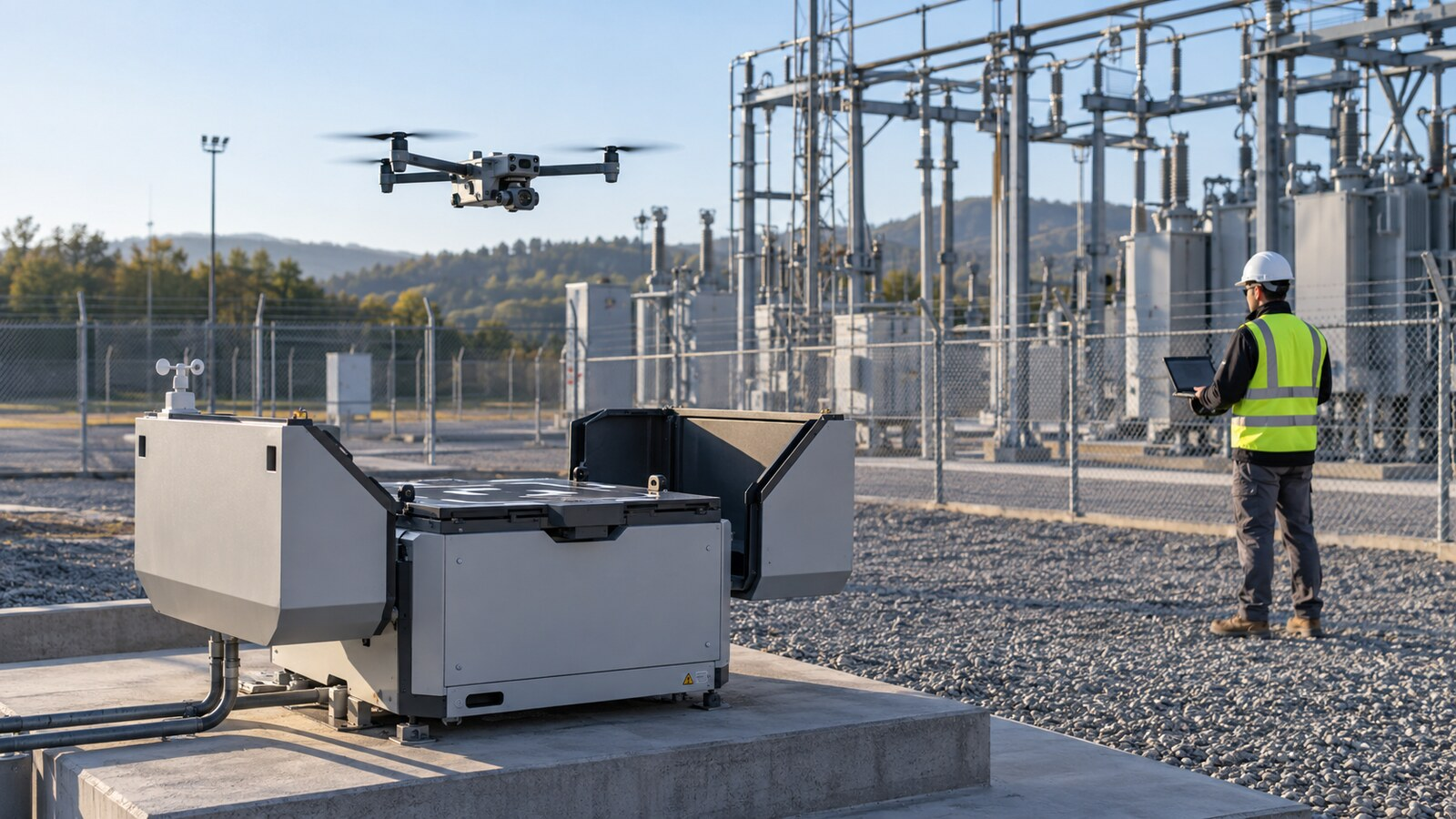
A drone-in-a-box system can automate launch, landing, charging, mission execution and data transfer, but it does not remove people—or regulation—from the operation. The real buying decision is whether repeated missions at one site justify permanent power, connectivity, weather monitoring, maintenance and remote oversight. If the operation also extends beyond visual line of sight, the operator needs the appropriate FAA authority; purchasing an autonomous dock does not supply it.
What “drone in a box” actually means
The phrase describes a compatible aircraft, weather-protected docking station and fleet-management platform designed to work as one remote operating system. The enclosure protects and charges the aircraft between missions. Software lets an authorized operator plan routes, monitor conditions, launch flights, review alerts and receive captured data from another location.
“Autonomous” needs careful interpretation. The aircraft may execute a programmed route and return to its dock without continuous stick input, but people still define the mission, approve or supervise operations, respond to abnormal conditions, maintain the equipment and remain accountable under the applicable operating authority. The system automates tasks; it does not become the responsible operator.
How a docked mission works
A typical cycle begins before the lid opens. The system checks aircraft and dock status, battery condition, communications and available weather information. A remote operator or approved workflow initiates the mission. The aircraft launches, follows a planned route, collects RGB, zoom, thermal or other sensor data, returns to the dock and lands using the positioning methods designed for that platform.
After landing, the dock charges the installed battery—or, on some systems, exchanges batteries—and transfers mission data through the configured network. Software can compare repeated imagery, flag exceptions or send information into an asset-management workflow. Those capabilities vary by manufacturer and subscription. Buyers should verify the exact aircraft, payload, processing and integration combination rather than assuming every dock performs the same cycle.
What current systems demonstrate
DJI says its Dock 3 supports Matrice 4D-series aircraft, remote operations through FlightHub 2 and fixed or vehicle-mounted deployment. Its published specifications list IP55 protection and an operating range from −30°C to 50°C. Those are manufacturer ratings, not permission to operate in every condition; wind, precipitation, visibility, airspace and the approved operating procedure still control whether a flight should occur.
Skydio’s Dock for X10 is another example. The company lists a temperature-controlled enclosure, a claimed launch time of about 20 seconds and remote operation features built around the X10 aircraft. Its own technical material also states that remote flight depends on connectivity and that BVLOS flight requires a waiver. That footnote captures the distinction buyers cannot ignore: technical capability and legal authority are separate.
The FAA’s BEYOND program shows docked operations in real infrastructure settings. The agency reports that Dominion Energy received a close-proximity, low-altitude BVLOS waiver in February 2023 for fixed-site drone-in-a-box inspections at generation facilities in six states. That is evidence of a specifically approved operating model—not a blanket authorization available simply by installing similar equipment.
The infrastructure matters as much as the aircraft
A dock is a small field installation, not an accessory case. A serious site assessment should address:
- Reliable electrical service, grounding and surge protection
- Primary and backup data connectivity
- A stable foundation, drainage and safe physical access
- Clear launch and landing geometry
- Local wind, temperature, rain, snow, dust and corrosion exposure
- Cybersecurity, user permissions and data retention
- Scheduled cleaning, calibration, inspection and firmware management
- A process for failed launches, poor landings and stranded aircraft
The most expensive failure may not be the dock itself. It may be unreliable communications, a poor mounting location, water intrusion, a blocked landing area or a data pipeline that produces files nobody can use. Ask who owns each layer and how quickly local personnel can respond when remote recovery is impossible.
Where repeated missions create value
Docked systems make the strongest business case when a defined site needs the same evidence repeatedly. Examples include substation condition checks, construction-progress documentation, solar-farm inspections, stockpile monitoring, perimeter awareness and public-safety response. Repetition makes route consistency, faster deployment and remote access valuable.
That does not mean every inspection should be automated. A changing site, occasional assignment or job requiring close human judgment may be better served by a mobile crew. Our roof-inspection workflow illustrates how much value comes from scoping, site control, systematic capture and careful reporting—work a dock cannot define by itself.
BVLOS remains the central operating constraint
Under ordinary Part 107 operations, the visual-line-of-sight rule in 14 CFR §107.31 still applies. An operator seeking to deviate from that rule must obtain the relevant FAA waiver and demonstrate that the proposed alternative can be conducted safely. The FAA’s waiver guidance describes that as an approval for a specific operation outside a Part 107 limitation—not a general product certification.
Proposed Part 108 would establish a broader framework for routine BVLOS operations, aircraft acceptance, operating permissions and supporting services. As of September 9, 2026, it remains a proposal rather than an operative replacement for Part 107 waivers. Buyers should not build a financial case on an assumed final date or assume the final rule will match every provision in the proposal.
Seven questions to ask before buying
- What repeatable decision will the data support? Define the inspection question and deliverable before choosing hardware.
- Can the site support the dock? Confirm power, network, foundation, weather exposure and physical security.
- Does the payload collect defensible evidence? Match RGB, zoom, thermal, mapping or other sensing to the client’s need.
- What operating authority is required? Map VLOS, BVLOS, controlled-airspace and other regulatory needs before promising remote coverage.
- Who supervises and responds? Name the remote operator, local responder and maintenance owner.
- Where does the data go? Verify security, retention, integration, review and customer-delivery requirements.
- What happens when automation fails? Require documented weather limits, abort logic, lost-link behavior and recovery procedures.
This workflow-first approach also applies to mobile equipment. Our guide to buying a commercial drone explains why the client deliverable should determine the aircraft—not the other way around.
The bottom line
A drone-in-a-box system can turn a drone from equipment transported to a job into infrastructure assigned to a site. That shift can shorten response time and make repeated data collection more consistent. It also creates new dependencies: permanent field hardware, reliable networks, software, maintenance, cybersecurity, trained oversight and operating authority.
The right question is not whether the dock can launch without someone standing beside it. It is whether the complete system can repeatedly produce useful evidence, manage abnormal conditions and operate within an approved safety case at a cost the mission can justify.
Reviewed September 9, 2026. Product capabilities and environmental limits are manufacturer claims unless otherwise stated. All About UAVs did not independently test the referenced systems. Verify current documentation, compatibility and FAA requirements before purchasing or deploying a docked UAS.