
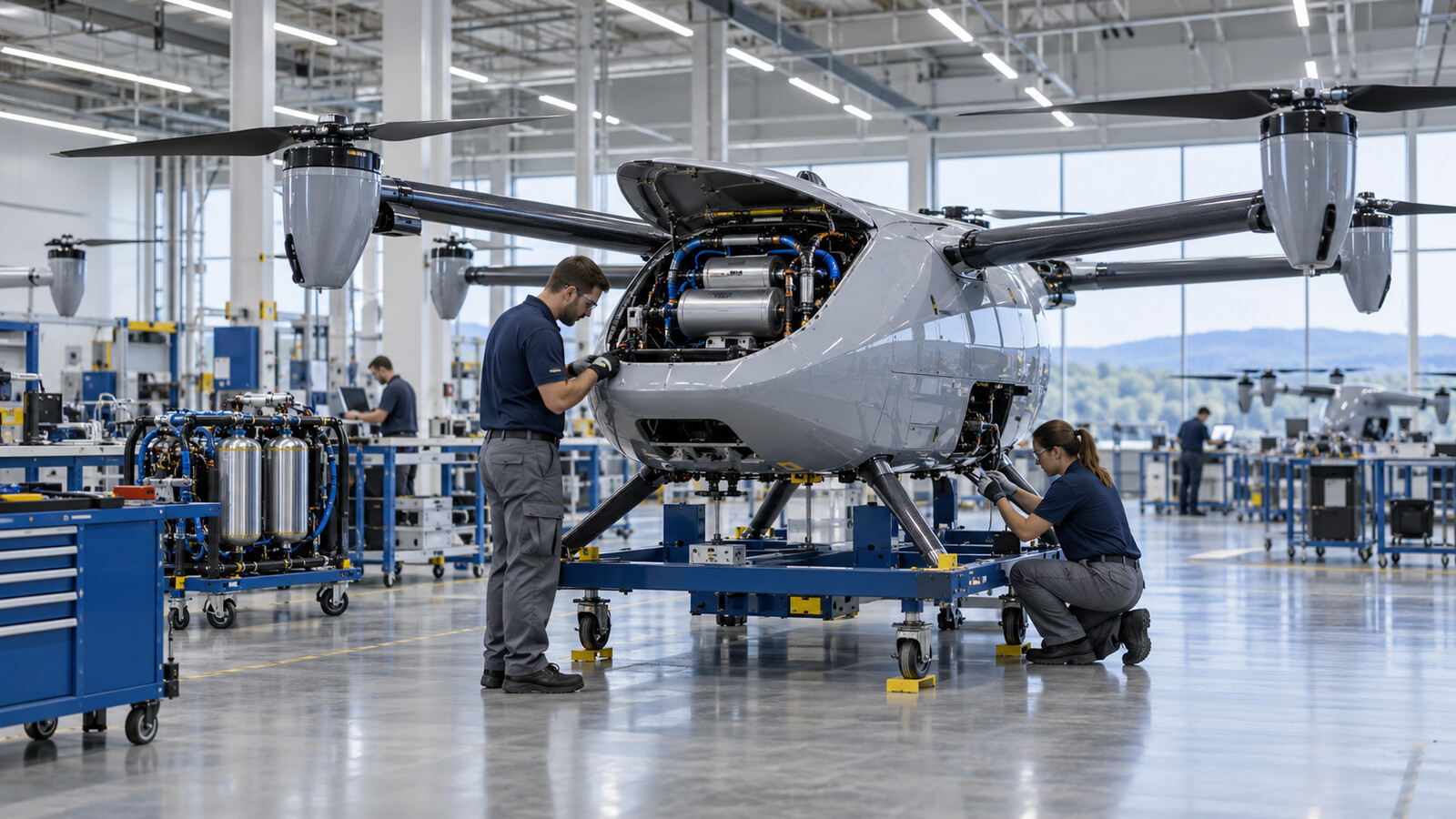
Heven AeroTech has opened a 56,000-square-foot production facility in Winchester, Virginia, establishing its first East Coast manufacturing site and the initial node in a planned nationwide network for hydrogen-powered unmanned aircraft systems. For commercial operators and public agencies, the larger story is not simply another factory opening. It is a test of whether hydrogen propulsion can move from specialized, low-volume aircraft into repeatable U.S. production.
What Heven AeroTech opened in Virginia
The company announced the Winchester facility on September 2. It says the site was brought online within 90 days and will serve as the operating model for additional locations around the United States.
According to Heven AeroTech, the Virginia operation brings production, quality systems, supply-chain development and operating procedures together under one roof. Future sites are planned to add hydrogen research laboratories, automated manufacturing infrastructure and space for technology partners. Those expansion plans and projected job totals remain company targets rather than completed results.
The new plant supplements the company’s manufacturing base in the Columbia River Gorge. Virginia Business also reported on the Winchester opening, while DRONELIFE detailed the facility’s role in the company’s national manufacturing strategy.
The Z1 is the immediate production focus
The facility will support production of Heven AeroTech’s Z1, a runway-independent vertical-takeoff-and-landing aircraft listed on the Defense Innovation Unit’s Blue UAS Select roster. Heven markets the aircraft for intelligence, surveillance and reconnaissance, infrastructure monitoring, emergency response and other missions that benefit from long endurance.
DRONELIFE reports company specifications of more than 10 hours of flight time, payload capacity up to 10 pounds, a maximum takeoff weight of 55 pounds and a cruise speed of 64 mph. These are manufacturer specifications, not independent All About UAVs test results. Real endurance will depend on payload, weather, operating profile and reserve requirements.
Why hydrogen propulsion matters
Battery-electric multirotors are excellent for short inspection, mapping and public-safety missions, but endurance declines quickly as payload and energy demand increase. Hydrogen fuel-cell systems offer a different tradeoff: potentially much longer flight time and faster refueling, balanced against more complicated fuel production, storage, transportation and field-support requirements.
That makes hydrogen especially interesting for persistent overwatch, long linear-infrastructure inspections, communications support and extended emergency-response operations. It does not automatically make hydrogen the best choice for every operator. Small teams flying brief missions may find conventional batteries simpler, cheaper and easier to support.
Domestic production is becoming part of the product
For government and critical-infrastructure customers, aircraft performance is only one purchasing criterion. Component origin, cybersecurity, supply continuity, maintenance support and compliance with procurement rules increasingly shape which systems can compete.
Heven AeroTech is positioning the Winchester plant as part of that answer. A repeatable domestic production system could shorten delivery and repair cycles while giving customers more visibility into manufacturing and quality controls. The meaningful proof points will come later: sustained production volume, delivery performance, field reliability and whether the proposed network actually expands.
What operators should watch next
- Production scale: whether the Winchester operation moves beyond initial Z1 output into steady, repeatable volume.
- Hydrogen logistics: how the company supports fuel generation, storage and refueling away from established facilities.
- Commercial adoption: whether long-endurance advantages translate into compelling operating economics outside defense programs.
- Network expansion: where additional U.S. facilities open and which suppliers or technology partners join them.
- Verified performance: customer deployments and independent evidence showing endurance, payload and reliability in real missions.
The Winchester opening does not settle the competition between batteries, hybrid power and hydrogen. It does show that hydrogen-powered UAS are entering a more industrial phase. If Heven AeroTech can pair manufacturing scale with practical field fueling and reliable long-duration performance, the technology could become a stronger option for operators whose missions regularly exceed the useful endurance of conventional multirotors.
Featured image: Original editorial illustration created for All About UAVs. It does not depict Heven AeroTech’s actual facility or aircraft.