Counter-drone capability is no longer a specialist purchase made one system at a time. NATO’s $40 billion commitment, Motorola Solutions’ $1.5 billion acquisition of D-Fend Solutions and an Indian manufacturing license for the Guardian-1 interceptor show governments and industry building a much larger detection-and-mitigation ecosystem.
The common pressure is economic as much as technical: inexpensive drones can force defenders to combine sensors, command software, electronic effects and interceptors that cost far more than the aircraft they are trying to stop. The winners will not necessarily be the systems with the most dramatic demonstration. They will be the ones that can identify threats reliably, fit within legal authorities and choose an effective response at a sustainable cost.
NATO commits more than $40 billion to counter-drone capability
The largest signal comes from NATO’s Drone Edge initiative. On July 7, NATO announced that allies intend to invest more than $40 billion in counter-drone capabilities over five years and train five times as many military drone operators by the end of 2027.
NATO also plans to establish a counter-drone marketplace for systems that are tested by NATO, compatible with alliance requirements and available for purchase. If implemented effectively, that model could make it easier for member countries to buy interoperable systems without building entirely separate national procurement pathways.
The commitment should not be mistaken for $40 billion in completed contract awards. It is a multinational investment plan whose results will depend on national budgets, procurement decisions, testing and fielding. Its importance is the scale and duration: counter-UAS is being treated as a standing element of alliance readiness rather than a temporary response to one conflict.
Motorola’s D-Fend acquisition brings counter-UAS into a larger security platform
Private-sector consolidation is moving in the same direction. Motorola Solutions completed its $1.5 billion acquisition of D-Fend Solutions on August 20. Motorola says it plans to integrate D-Fend’s counter-drone technology into its public-safety and critical-infrastructure ecosystem.
D-Fend’s EnforceAir platform uses radio-frequency cyber technology to identify certain unauthorized drones, take control of them and direct them toward a designated landing area where the operator has legal authority to do so. That differs from broad jamming or kinetic interception, which can create communications disruption, debris or collateral risk.
RF takeover is not a universal solution. Autonomous aircraft, unfamiliar protocols, modified communications links and other threat types may require different detection or mitigation layers. Motorola’s investment is therefore best understood as a move to add a specialized counter-drone capability to a broader command, communications and public-safety portfolio—not proof that one technology can defeat every drone.
Our earlier coverage of the Pentagon’s directed-energy testing and expanding local counter-drone authority explains why the legal user and operating environment matter as much as the hardware.
Guardian-1 licensing points toward localized interceptor production
India’s Paras Defence & Space Technologies has also signed an exclusive intellectual-property licensing agreement with Tandem Defense LLC, a subsidiary of Autonomous Power Corporation, for the Guardian-1 interceptor. According to the company disclosure reported by ET Manufacturing, the agreement gives Paras Defence exclusive rights to manufacture and commercialize the system in India.
The reported license is non-transferable and non-sublicensable, applies within India and has an initial 12-month term that may be renewed by mutual consent. Guardian-1 is described by the companies as a high-speed, battery-powered interceptor intended to counter lower-cost aerial threats.
This is a manufacturing and commercialization agreement—not evidence that the Indian military has selected Guardian-1 for operational service. Public reporting does not establish a completed defense procurement, independently validated performance or fielded production volume. Those distinctions matter when evaluating early counter-UAS announcements.
Why layered counter-UAS systems are attracting investment
No single sensor or defeat mechanism covers every threat. Radar may struggle with clutter or very small targets. RF detection depends on signals it can recognize. Electro-optical systems require line of sight and can be affected by weather or lighting. Jamming, cyber takeover, directed energy and kinetic interceptors each carry different limitations, authorities and costs.
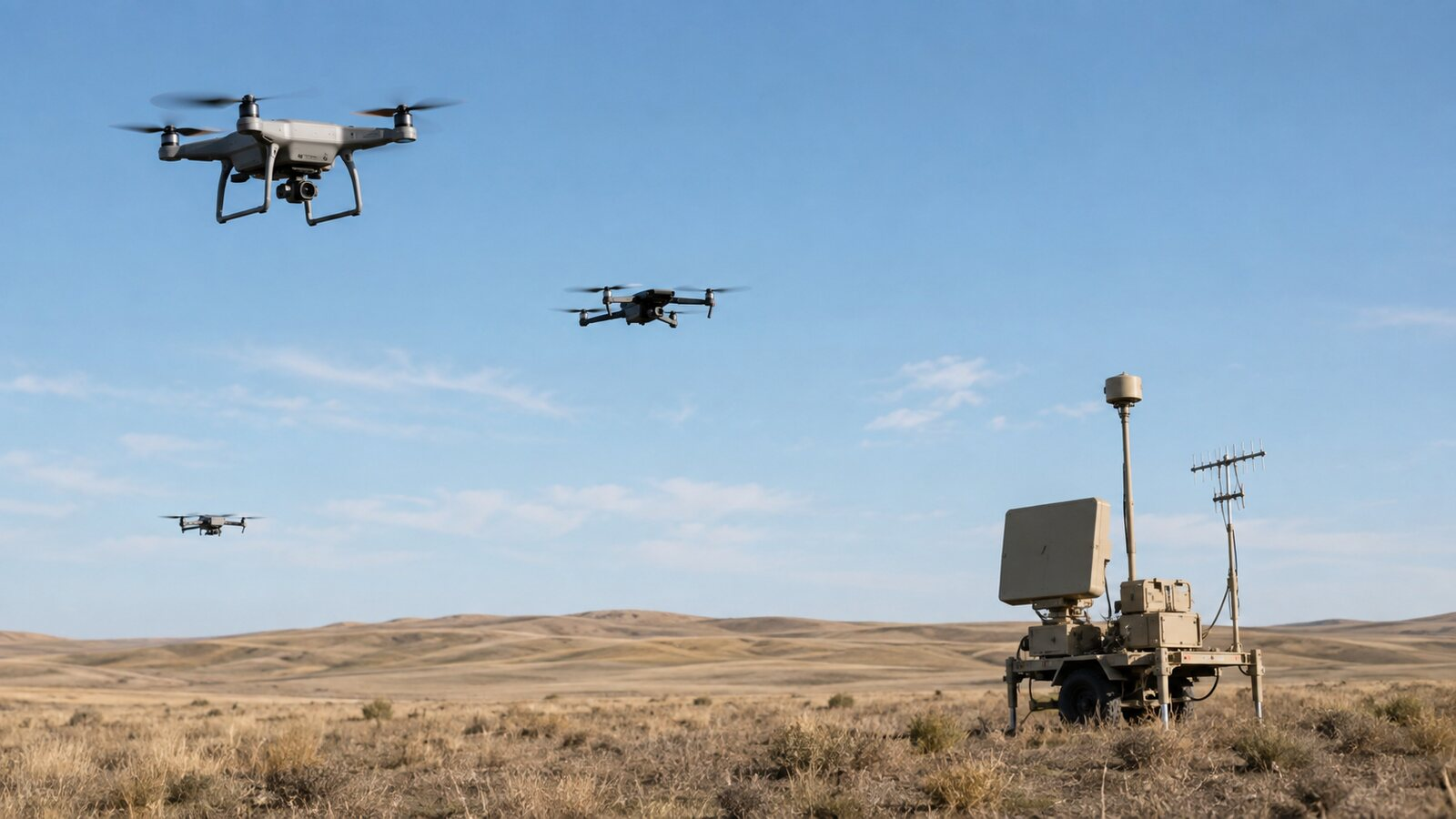
That is why counter-UAS is evolving into a layered system:
- Detection: Radar, radio-frequency sensors, acoustics and electro-optical or infrared cameras.
- Identification: Software that separates authorized aircraft, false alarms and credible threats.
- Command and control: A common operating picture that helps personnel select and authorize a response.
- Mitigation: Electronic, cyber, directed-energy or kinetic options chosen for the threat and environment.
- Training and policy: Qualified operators, defined authority and procedures for escalation and evidence retention.
The U.S. market reflects the same challenge. Our analysis of the Pentagon’s $21 billion drone-defense push shows that funding alone does not guarantee the institutional knowledge needed to field effective systems.
What buyers should verify
Large budgets and acquisitions make the market important, but they do not eliminate performance risk. Procurement teams should ask:
- Which drone types and control methods were included in testing?
- What are the demonstrated detection range and false-alarm rate under realistic conditions?
- Can the system distinguish authorized aircraft from threats?
- What happens when a drone is autonomous, frequency-agile or operating without a familiar control link?
- Who has legal authority to activate the mitigation method?
- What is the full cost per protected site and per engagement?
- How does the system integrate with existing sensors, communications and incident-command tools?
The clearest conclusion is not that one counter-drone technology has won. It is that governments and major security companies increasingly see low-altitude airspace protection as a permanent, integrated mission. NATO’s marketplace, Motorola’s acquisition and localized interceptor production are three different responses to the same demand for counter-UAS capability at scale.
Reviewed and updated: August 31, 2026. Company performance descriptions are based on published statements and have not been independently tested by All About UAVs.