New York has added a new Class A misdemeanor for unlawful drone use, establishing state criminal penalties for certain dangerous operations and unauthorized flights over defined “prohibited space.” The law took effect August 25, 2026—not August 26 as some early summaries reported.
The measure appears in Part D of Chapter 55 of the Laws of 2026, signed by Governor Kathy Hochul on May 27. It added Article 280 to the New York Penal Law and also created a framework for trained law-enforcement officers to mitigate credible drone threats under state and applicable federal authority.
For pilots, the most important point is that the final statute does not simply criminalize every drone flight near infrastructure. It defines specific prohibited conduct and includes substantial protections for compliant recreational and professional operations. Operators should nevertheless document their legal authority and site authorization carefully because the law’s geographic definition is broad and has not yet been interpreted by courts.
What New York Now Calls Unlawful Drone Use
New Penal Law Section 280.05 makes “unlawful use of a drone” a Class A misdemeanor when a person either operates a drone in a statutorily defined “nefarious manner” or operates over prohibited space without express prior approval from someone the operator reasonably believes can grant that approval.
Despite its unusual wording, “nefarious manner” is not left entirely to ordinary interpretation. Section 280.00 lists conduct that qualifies, including using a drone to commit or facilitate a crime; recklessly creating a substantial risk of injury or property damage; knowingly interfering with emergency, law-enforcement, search-and-rescue, disaster-response, or medical-evacuation operations; and using a drone for harassment, intimidation, stalking, surveillance, or physical menacing that otherwise violates state or local law.
The definition also covers delivering or facilitating contraband at secure facilities, operating a drone equipped or used to release an object or substance in a way that creates substantial safety risks, and unauthorized surveillance of a state or federal military installation.
Which Locations Count as Prohibited Space?
The statute’s “prohibited space” list includes airports; state or federal military installations; correctional facilities; police and fire stations; emergency-dispatch stations; schools; critical infrastructure; and large public gatherings of at least 500 people, including concerts, festivals, and sporting events.
The final text uses a detailed three-dimensional boundary. It includes areas within 500 feet horizontally of a listed location’s outer perimeter and specified airspace above the location, including airspace up to 400 feet above the ground within its boundaries. It also addresses flights at greater vertical distances above those boundaries when they are not authorized by the FAA.
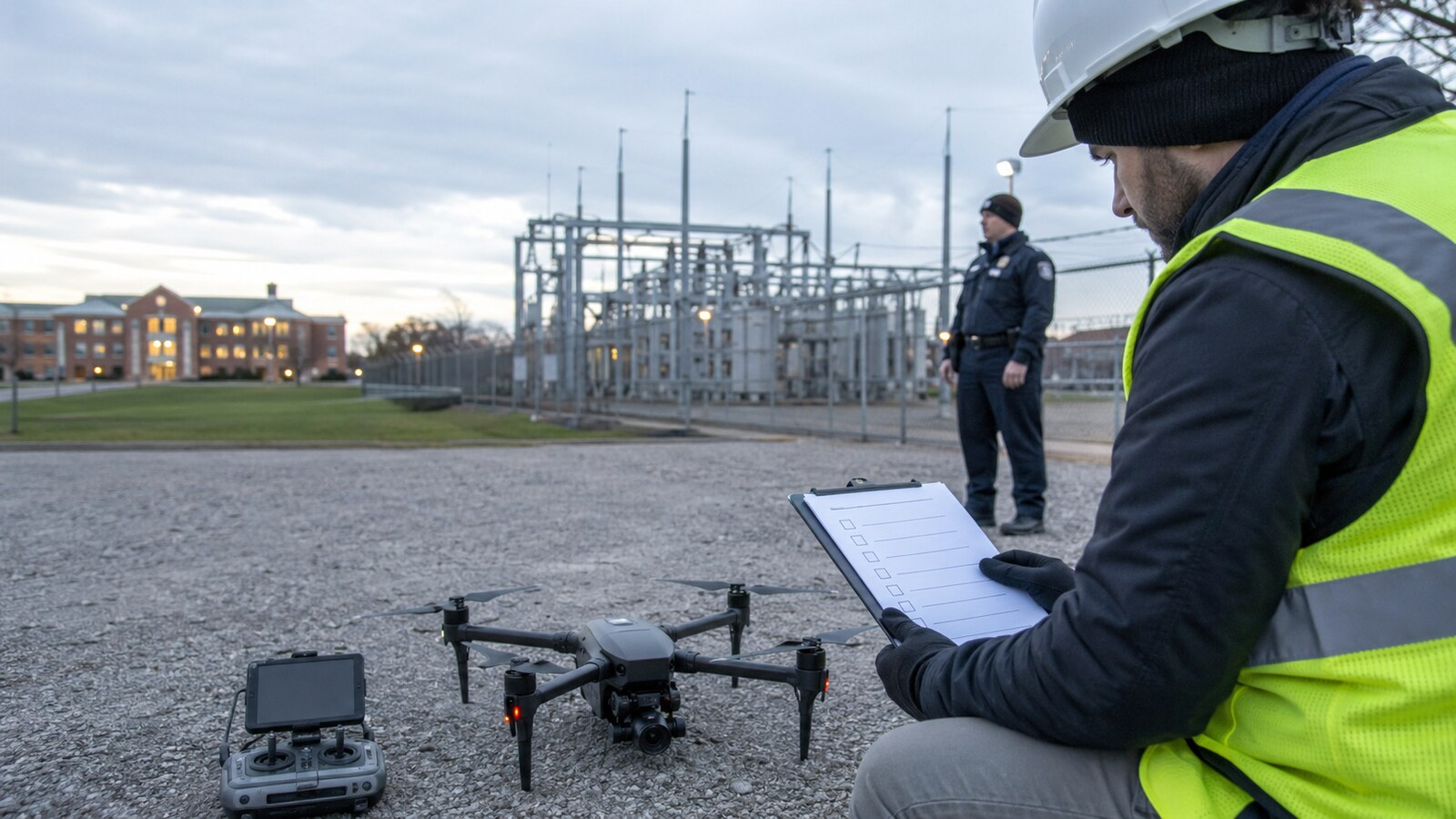
Because this geometry and its interaction with federal airspace authority are legally complex, operators should not rely on an app’s airspace display alone. FAA airspace authorization and permission from the person controlling a protected site address different questions. For sensitive-site work, retain both the federal authorization or waiver required for the operation and written evidence of the property or facility authorization supporting the flight.
The Final Law Protects Many Lawful Drone Operations
Early summaries can make the statute sound like a blanket 500-foot exclusion zone. The final enacted language is more qualified. Section 280.10 says Article 280 does not apply to compliant commercial, educational, agricultural, journalistic, infrastructure, or other lawful operations unless the drone is operated in a way that recklessly creates a substantial risk of physical injury or property damage.
It similarly protects recreational operations conducted in compliance with applicable federal, state, and local requirements, subject to the same reckless-risk limitation. A more narrowly defined “toy drone”—no more than 0.55 pounds, flown within visual line of sight, lacking a camera or other recording or transmission sensor, and used only recreationally—also receives protection unless operated recklessly.
Government employees and people acting for state or local entities are excluded when acting consistently with governmental duties. These provisions matter: a properly planned infrastructure inspection or journalistic operation is not automatically criminal simply because it occurs near a listed location.
What Part 107 Operators Should Change Now
- Screen the site, not only the airspace. Check for schools, public-safety buildings, correctional facilities, airports, critical infrastructure, military sites, and large scheduled gatherings near the operating area.
- Obtain written facility authorization. Identify the person with authority over the site and preserve the approval, scope, date, time, and contact information with the mission record.
- Keep federal documentation separately. Save FAA authorizations, waivers, registration, Remote ID information, and pilot credentials. Site permission does not replace federal compliance, and federal approval does not necessarily replace facility authorization.
- Strengthen emergency procedures. Brief the crew to land or reposition immediately if the operation could interfere with police, fire, medical, evacuation, or search-and-rescue activity.
- Document the lawful purpose. Retain the work order, contract, news assignment, agricultural purpose, lesson plan, or infrastructure-inspection scope that supports the statutory protection for the flight.
- Reassess public events. A gathering becomes especially relevant at 500 or more people, so confirm event timing and boundaries during preflight planning.
Law-Enforcement Mitigation Authority Is a Separate Issue
Chapter 55 also directs the state police superintendent to establish rules, training, and reporting requirements for police and peace officers using drone-mitigation measures. The statute requires reasonable suspicion before qualifying officers use non-kinetic measures and probable cause before kinetic measures, along with compliance with applicable federal law.
The existence of that state framework should not be read as unlimited authority for any officer or agency to jam, intercept, or destroy an aircraft. Training, state regulations, federally approved technology, evidentiary thresholds, and federal legal restrictions remain important conditions.
Unsettled Questions Remain
The new law’s practical reach will depend on enforcement decisions, implementing regulations, and eventual judicial interpretation. Questions remain about how operators and police will map the 500-foot boundary, identify all covered critical infrastructure, verify who can authorize a flight, and apply the professional-operation exemption in contested circumstances.
This article provides general operational information, not legal advice. Operators planning work near a covered site should review the final statute and obtain legal guidance when the mission presents unusual risks or unclear authority.
Sources
- New York State Legislature: A10005C, signed as Chapter 55 of the Laws of 2026.
- Official enrolled bill text: S9005C/A10005C.
- New York State Association of Chiefs of Police: Chapter 55 overview, June 17, 2026.
- Beveridge & Diamond: FAA critical-infrastructure restrictions and New York law update, June 26, 2026.