
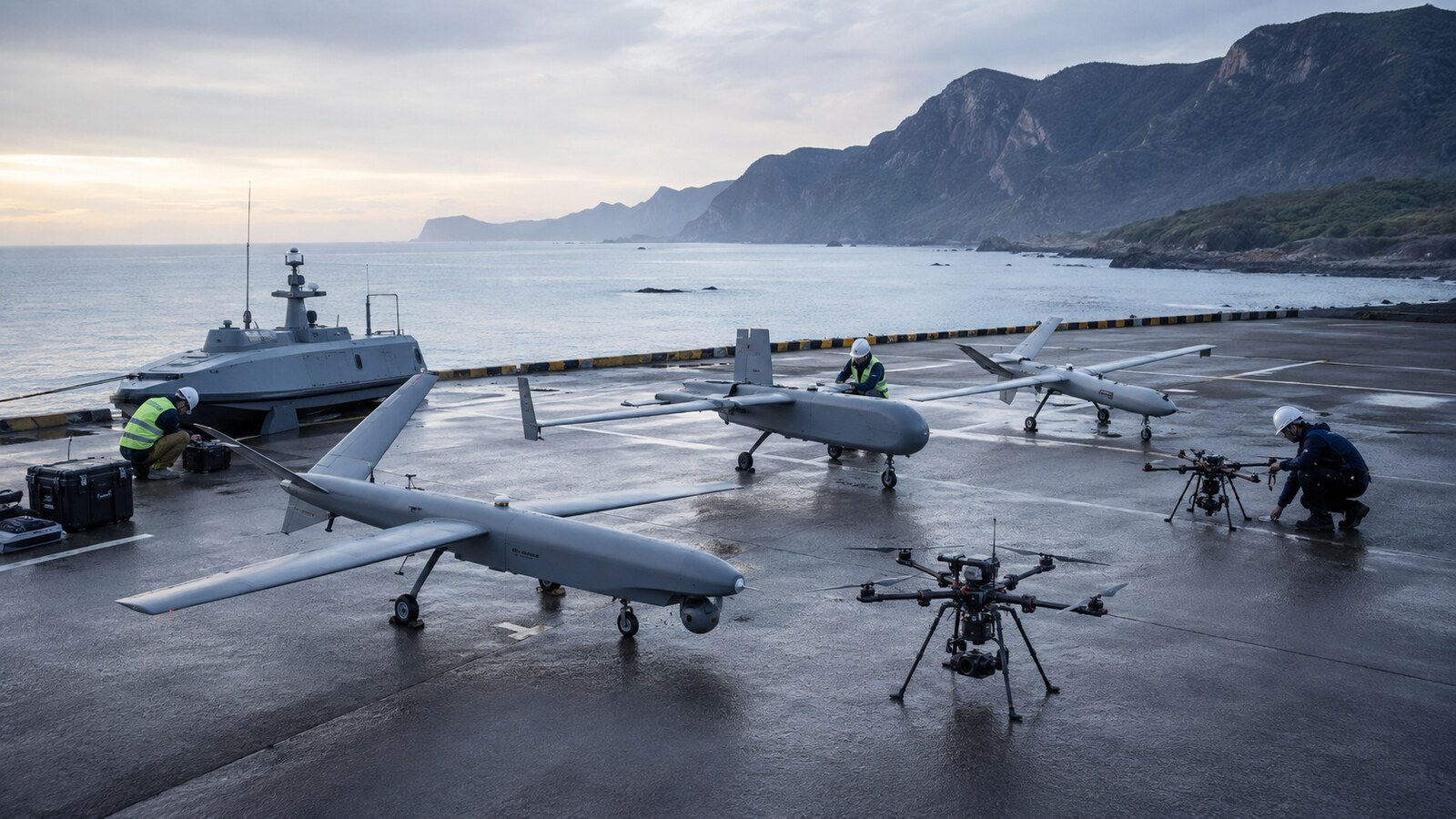
Taiwan’s Legislative Yuan rejected the Cabinet’s six-year NT$210 billion (about US$6.6 billion) special-budget proposal for military drones and instead passed an opposition-backed framework capped in principle at NT$240 billion (about US$7.56 billion).
The measure approved August 27 would use regular annual budgets rather than the Cabinet’s special fund, generally limiting spending to NT$40 billion per year while allowing additional funding with legislative approval. The result preserves a large domestic uncrewed-systems program but changes its funding mechanism, oversight and likely procurement timing.
What the Rejected NT$210 Billion Proposal Would Have Bought
The Executive Yuan approved the draft special act on June 18. Its stated scope includes domestically produced coastal surveillance and reconnaissance drones, coastal attack drones, and small uncrewed surface vessels intended for attack missions. Funding would run from August 2026 through December 2031.
Reuters reported that the broader government procurement goal encompasses roughly 210,000 military drones. That figure describes the planned scale of the program; it does not mean that Taiwan has already awarded contracts or taken delivery of 210,000 systems. Public materials reviewed for this article do not provide a complete model-by-model breakdown, supplier list, unit price, delivery schedule, or domestic-content percentage.
President Lai said modern conflicts in Ukraine and the Middle East demonstrate the growing role of uncrewed weapons. He characterized drones as a key part of Taiwan’s effort to build relatively affordable, mobile, and distributed capabilities that could complicate a larger opponent’s operations across the Taiwan Strait.
Why the Legislature Chose a Different Framework
Opposition parties, which control the Legislative Yuan, backed the version that ultimately passed. It provides up to NT$240 billion over six years through regular annual budgets, with a general NT$40 billion annual cap and a larger role for the Ministry of Economic Affairs.
Opposition lawmakers argued that annual appropriations would strengthen oversight and allow procurement to adjust as drone technology changes. Government officials warned that the cap could interfere with contract payment schedules and weaken the long-term demand signal needed for manufacturers to expand production.
Defense Minister Wellington Koo said the Ministry of National Defense expects drone-related spending of NT$42.1 billion in 2027—already above the framework’s normal annual ceiling. The enacted language allows additional funding with legislative approval, but that process could affect timing.
Separate Drone Funding Has Already Passed
The newly passed framework should not be confused with other drone-related spending approved earlier in August. Taiwan’s parliament separately passed NT$63.4 billion for industrial development and procurement by government agencies.
The distinction matters because the Cabinet’s US$6.6 billion proposal did not pass. The enacted framework establishes a different ceiling and annual-budget process; it does not mean that NT$240 billion has already been appropriated, contracted or spent.
What the Plan Could Mean for Taiwan’s Drone Industry
If funded consistently through future annual budgets, the program could provide Taiwanese manufacturers with longer production runs and more predictable demand for airframes, propulsion, communications, sensors, control systems and maritime platforms. It also supports Taiwan’s stated objective of building a “non-red” supply chain that is not dependent on components from China.
However, the size of the authorization alone would not establish manufacturing capacity or operational effectiveness. Execution would depend on requirements, testing, supply-chain qualification, contract awards, training, maintenance, communications resilience, and the ability to update systems as counter-drone technology evolves.
What the Vote Changes—and What Comes Next
The approved framework shifts the program toward annual appropriations and legislative oversight. Taiwan’s Defense Ministry expressed regret over rejection of the Cabinet version, while Premier Cho Jung-tai said the government would assess whether the enacted approach meets national-defense and industrial-development needs.
The next evidence to watch is the annual budget implementation: responsible agencies, contract notices, named suppliers, production targets, testing requirements and delivery milestones. The vote authorizes a framework, not completed procurement or delivery, so claims about winners, unit costs or operational capability remain premature.
Sources
- Focus Taiwan: Legislature passes rival NT$240 billion drone framework, August 27, 2026.
- Reuters: Taiwan parliament rejects government plan and passes its own version, August 27, 2026.
- Executive Yuan: Cabinet approves draft special act to boost unmanned defense capabilities, June 18, 2026.
- Reuters: Taiwan president pushes $6.6 billion military drone bill ahead of crucial vote, August 26, 2026.
- Taipei Times: Legislative committee fails to agree on drone act, August 20, 2026.
- Focus Taiwan: Funding and oversight gaps divide competing drone bills, August 26, 2026.